Cover
Downxtown
A Brand Commerce Platform
Android App — Live
Built in Lucknow, India · 2026
The Problem
Each Channel Does One Thing.
None Of Them Do ENOUGH.
A ₹10L–₹1Cr/month D2C brand is already on three channels simultaneously — and each one
fails them in a different, compounding way.
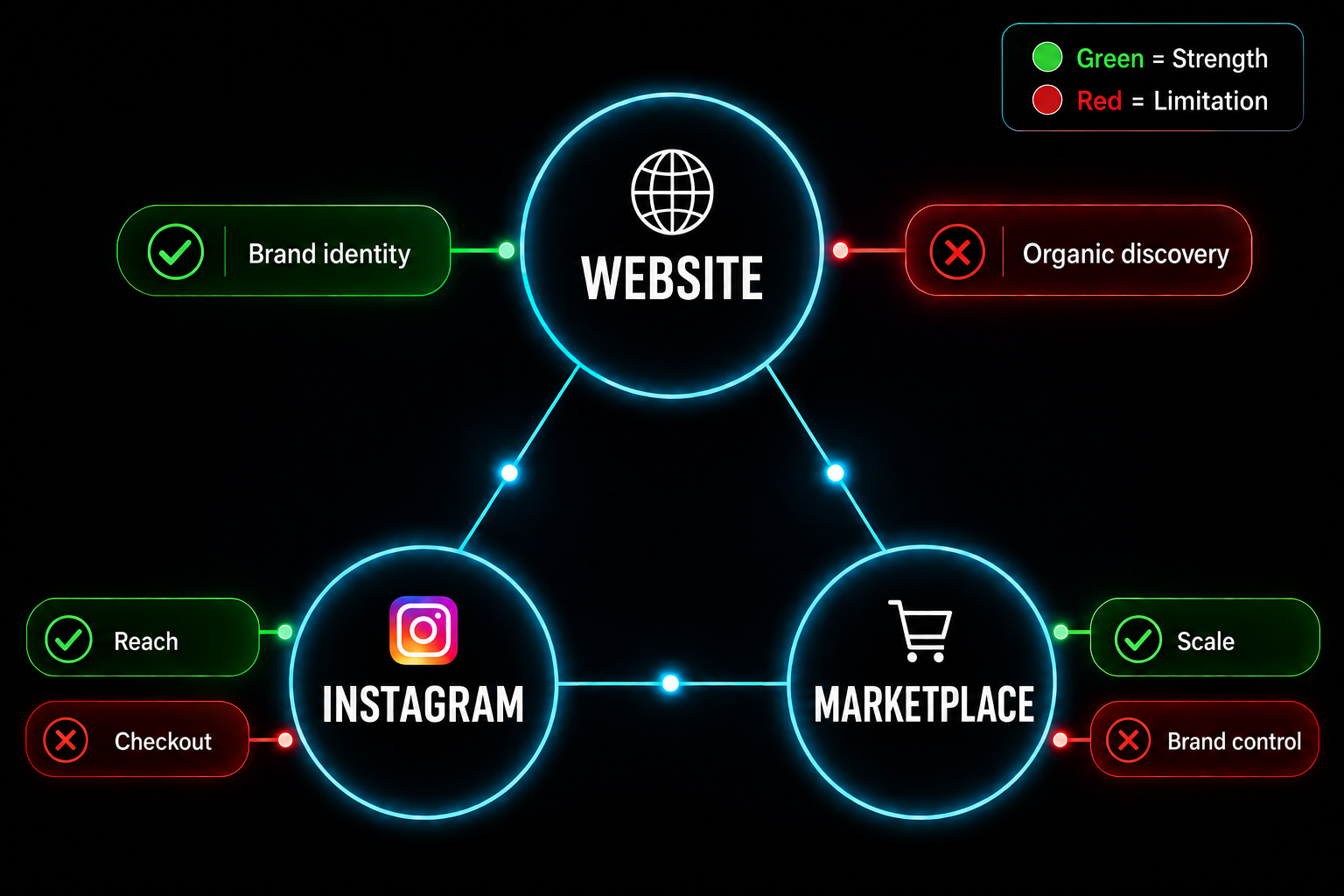
Website
Good: Brand Identity, Brand Story
Failure: No organic discovery
→ Traffic dies the moment ads stop
Instagram
Good: Organic Discovery, Reach
Failure: Broken buying journey
→ Intent leaks before checkout (70% abandon)
Marketplace
Good: Traffic, Scale
Failure: Brand identity gets erased
→ You become a listing, not a brand
→ Customer relationship is owned by the platform
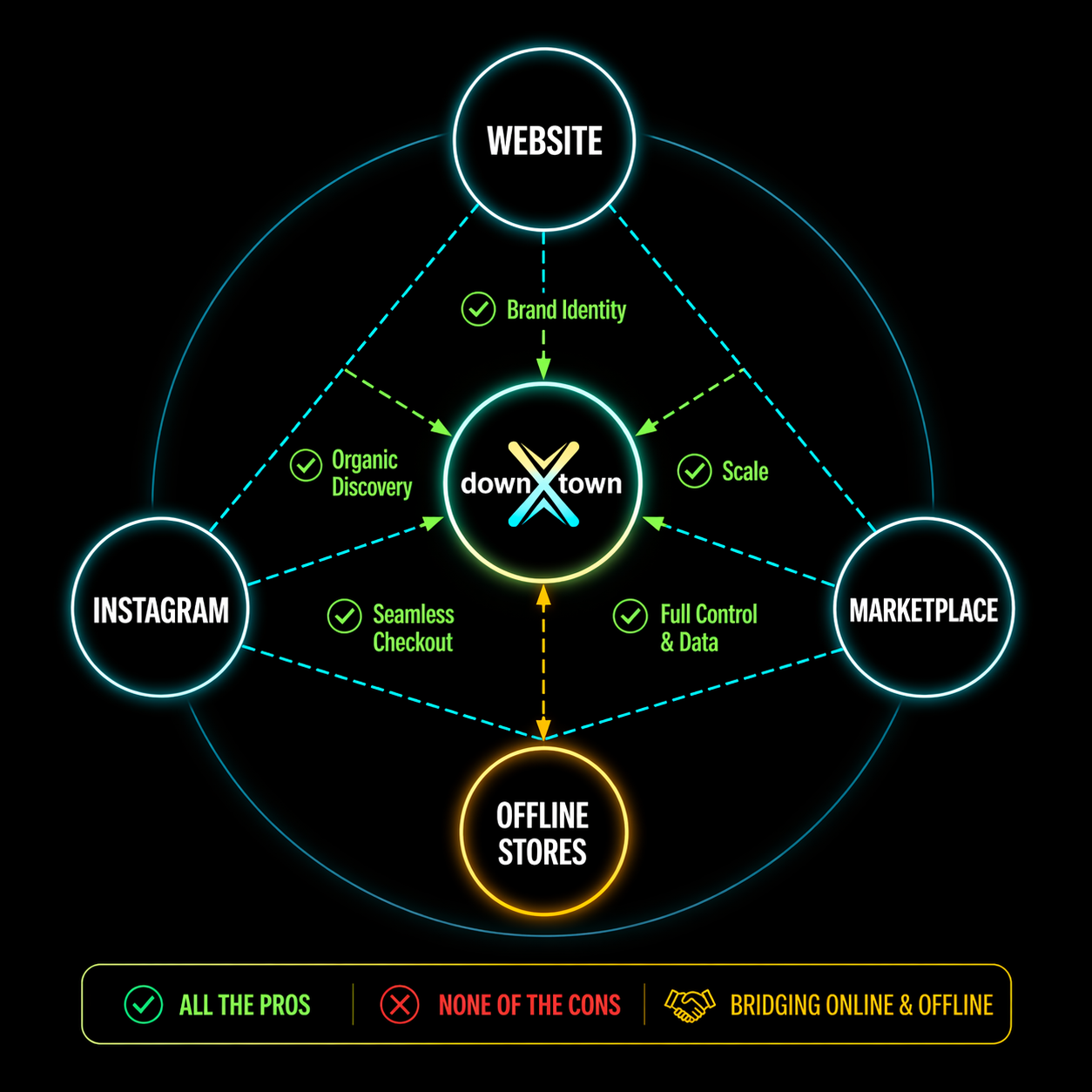
The Triangle
Three channels. Three corners. Each strong in one dimension, broken in the others. What if one platform
sat at the center of the triangle — inheriting the strength of each, without the failure of any?
“India has thousands of genuinely great D2C brands permanently trapped at a growth ceiling because the
infrastructure was never designed for them.”
The Problem (Zoom Out)
And This Problem Is Bigger Than DIGITAL
The three-channel problem is what every D2C brand founder feels daily. But zoom out — and the gap is even
larger.
Offline Reality
15M+ offline stores
No discovery layer
No connection to D2C brands
Completely outside the digital loop
This isn’t just a channel problem.
It’s a broken commerce infrastructure.
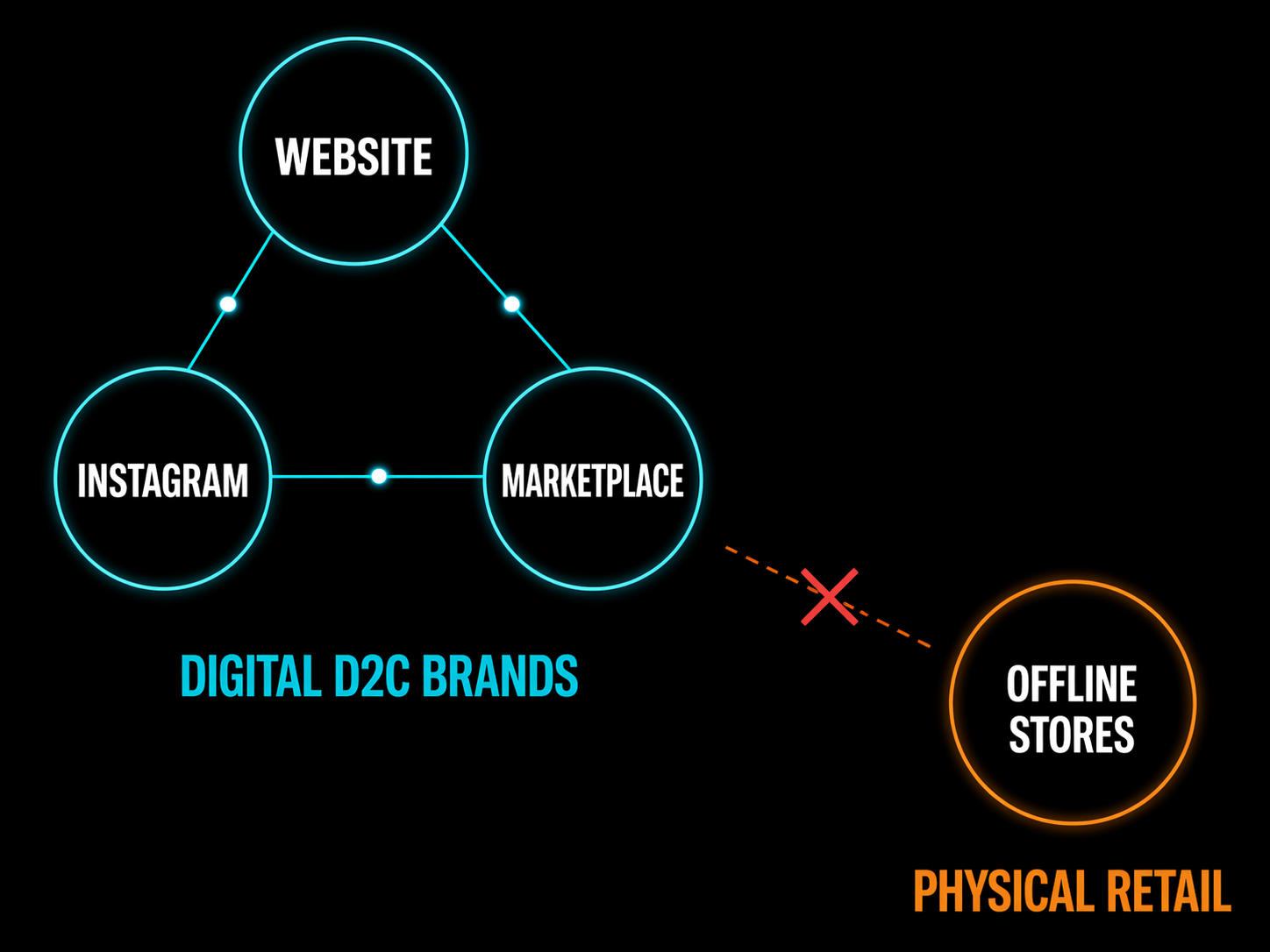
Visual: add offline-disconnect-diagram.png to show the offline
disconnect diagram.
The Market
The D2C WAVE Is Already Here
India’s D2C market is estimated at $12–15B in 2026, up from under $5B in 2020, growing
at 25–30% annually (industry estimates and consulting reports), and projected to reach
$55–60B by 2030 (projection — add/verify source before pitching).
$12–15B
Indian D2C Market (2026)
25–30% CAGR
Projected: $55–60B by 2030
Supporting Signals
800+ active D2C brands
Across beauty, personal care, fashion, food, home, electronics
From <$5B in 2020 → $12–15B in 2026.
Rapid growth. Fragmented ecosystem.
The Solution
The Center Of The TRIANGLE.
Downxtown unifies identity, discovery, and scale — without the trade-offs of existing channels.
Problem → Outcome
Discovery Problem
No Organic Discovery (Website)
→
Momentum-based visibility
Engagement drives reach, not ad spend
Conversion Problem
Intent Dies Before Checkout (Instagram)
→
Discovery + purchase in one place
No redirects. No drop-offs
Brand Problem
Brand Becomes a SKU (Marketplace)
→
Brand-first profiles
Story, catalogue, followers, reviews
Ownership Problem
Platform Owns the Customer (Marketplace)
→
Direct relationships + owned data
Every interaction belongs to the brand
Distribution Problem (Offline)
Offline Retail is Disconnected
→
Stores become discoverable
Brands list their physical stores; users discover nearby locations and browse collections
Ownership Advantage
The Channel Brands OWN.
On marketplaces, the platform owns the customer.
On Downxtown, the brand does.
Direct Conversation
Customers interact with brands before and after purchase.
No intermediaries. No lost intent.
Owned Relationships
Every buyer becomes a long-term audience.
Follow, message, and re-engage directly.
Direct Reach
Brands engage customers directly — with fully custom notifications
Campaigns, drops, offers, storytelling — on their own terms
Marketplace brands are anonymous suppliers.
Downxtown brands are independent businesses.
The Product
What The App DOES
1.
Discovery
How users find brands
Brand Feed
Discover brands through a feed — not product listings.
Follow brands, not just products.
2.
Identity
How brands exist
Brand Profile
Full storefront: catalogue, story, followers, reviews.
Website depth + marketplace reach.
3.
Relationship
What happens between brand & user
Follow Model
Follow once → every drop reaches the user. Direct, algorithm-independent channel.
Direct Messaging
Pre- and post-purchase communication.
Custom orders, support, loyalty, retention.
4.
Conversion
How buying happens
Discovery + Purchase in One Flow
No redirects. No drop-offs.
5.
Distribution Expansion
Turn nearby stores into active distribution channels
Nearby Discovery
Offline inventory becomes visible online.
Users discover and shop from nearby stores.
6.
Social Layer
Shopping becomes social again — influence, not isolation
Social Shopping
Browse with friends, see what others follow.
Commerce with context.
Categories · Search · Reviews · Store Listing · Website Attribution
Traction
The Product Is Built.
And It WORKS.
Pre-revenue. Pre-brand-partnerships. Pre-users. What exists is a complete, functional product — built
solo, in under a year, from Lucknow, with no funding, no team, and no prior experience shipping at this scale.
What is live and working today
✓
Android app live on Google Play Store. End-to-end functional product.
✓
Brand discovery feed with brand cards, catalogues, brand profiles.
✓
Catalogue system browseable, searchable, filterable by category.
✓
Purchase flow: buyer taps a product → redirected to brand’s own checkout. Downxtown
takes zero commission on the transaction.
✓
Direct messaging layer built. No platform wall between brand and buyer.
What this round buys
The product works. What doesn’t exist yet is formal brand supply: brands who have actively onboarded
under their own control. This raise converts a working product into a live marketplace.
Shopify Connector - In Development
One install on the Shopify App Store. Catalogue synced automatically. Every Shopify brand becomes a
potential Downxtown brand instantly.
Built in Lucknow. Solo founder. First build. Shipped in under a year.
The product is the proof of the founder.
Business Model
Revenue That Scales With BRANDS
Downxtown starts with a subscription model — predictable recurring revenue that aligns platform and brand
incentives. As the platform scales, additional revenue layers activate. The model follows the math:
subscriptions first, with commission or hybrid structures considered if the economics demand it.
Brand Subscription (Now)
| Tier |
Catalogue Size |
Price |
| Starter |
Up to 100 products |
₹999 / month |
| Growth |
101–500 products |
₹2,499 / month |
| Scale |
500+ products |
₹4,999 / month |
Annual plans at 20% discount
Local Retail Store Subscription (Now)
Store owners pay monthly to appear in the Nearby Discovery feed: ₹499–₹999/month per
store location. High-volume stream — every city and town in India is a market.
Physical Store Listing for Brands (Now)
Brands list offline stores on their profile. Tiered by location count: 1–20 / 21–50 / 50+.
₹299–₹999/month add-on.
Shopify Connector (Coming Soon)
Subscription or transaction revenue via Shopify App Store, tied to Shopify’s merchant ecosystem.
In-App Brand Advertising (Growth Stage)
Brands pay to amplify reach beyond their organic follower base: promoted positions in the discovery feed,
featured brand placements, and boosted notifications to targeted shopper segments. Organic reach is
always free. Paid reach is optional. High-margin inventory that scales with platform traffic.
Premium Analytics (Growth Stage)
Behavioural intelligence across online discovery + offline touchpoints. What shoppers follow, click, and
buy — sold as a brand intelligence product.
B2B Distribution (Series B+)
Platform becomes direct distributor: brand inventory to retailer godowns. Eliminates traditional
distributor and wholesaler layers. Significant margin opportunity enabled by the data layer.
Unit Economics Sketch (Year 1 Target)
100 brands × ₹2,000 avg/month = ₹24L ARR
500 brands × ₹2,000 avg/month = ₹1.2Cr ARR
Ads and analytics revenue additive on top as platform scales.
Why Now
The Window Is OPEN.
01 — D2C Wave is Past Early Adopters
India had ~2,000 D2C brands in 2018. It has 50,000+ today.
(Source: DPIIT / Nasscom D2C Landscape 2023)
02 — The Indian Shopper is Evolving
Gen Z follows brands, not stores. They buy on trust, not just price. 80%+ discover products via social media
before purchasing.
(Source: Meta India / BCG Digital Consumer Report 2023)
03 — Offline Retail Waits for a Bridge
15 million stores. Hundreds of thousands of independent retailers. Almost entirely disconnected from the
digital brand ecosystem. The platform that bridges this at scale will own a durable position.
“The window is open. It will not stay open forever.”
Built in India. For Indian Brands.
The Founder
First Build. Full Stack.
No SAFETY NET.
Abdullah
Founder & CEO · Downxtown · Lucknow, Uttar Pradesh
What he built
Downxtown — end to end. Alone.
✓
Android app (Jetpack Compose) — designed, built, shipped to Play Store
✓
Backend (Ktor) — API, auth, data layer, catalogue sync
✓
Brand feed, brand profiles, follow model, DM layer, purchase flow
✓
Every screen. Every endpoint. Every product decision.
Why this founder for this problem
I–ve spent a lot of time deeply understanding how D2C brands grow –
where discovery fails, intent drops, relationships get lost, etc.
Downxtown is the result of that work: a system built end-to-end to organize and streamline brand commerce.
Why Lucknow
We’re currently building from Lucknow – that’s where I’m based.
Post-funding, we plan to move to Gurgaon to be closer to D2C brands, retail partners, and the startup
ecosystem.
What the raise adds
The product is built. Now it’s about distribution.
This round helps onboard the first 100 brands and scale the network.
Deployed into hiring, infrastructure, and brand acquisition.
The Vision
What Instagram Is To Creators —
Downxtown Is To BRANDS.
Instagram didn’t invent creative people. It gave them infrastructure: a home where identity lived, audience
compounded, and growth didn’t reset. Indian D2C brands are exactly where creators were in 2009. The products
are real. The founders are serious. The infrastructure doesn’t exist yet.
For the brand founder
The permanent home for their brand and the complete center of operations for their digital and physical commerce.
For the customers
A go-to platform to discover and understand new brands, be a part of their community, and hold them as a badge of flex.
“India is producing world-class brands.
They deserve world-class infrastructure.”
Made in India. For Indian Brands.
The Ask
Let’s Build TOGETHER.
Raising
₹25 Lakhs
Capital Deployed Across
→ Product development & engineering
→ Brand acquisition & onboarding (target: 100 brands)
→ City-level retail network building (target: 500 stores, 2 cities)
→ iOS app development
→ Shopify Connector launch
→ Data infrastructure for distribution model
18-Month Milestones
| Milestone |
Target |
| 📦 Active Brands |
100 (Fashion, Footwear, Cosmetics across Tier 1 & 2) |
| ⬡ Shopify Brands via Connector |
50 (one install, zero rebuild) |
| 🏢 Retail Stores Listed |
500 stores across 2 metro cities |
| 📱 iOS App + Active Users |
5,000–10,000 engaged shoppers |
| 🏛 Offline Store Listing Pilots |
10 brand partners with physical retail |
| 💰 ARR at Month 18 |
₹24–30L ARR (100 brands × avg ₹2,000/mo) |
At 100 paying brands, Downxtown demonstrates brand-side willingness to pay. At 5,000 active shoppers, it
demonstrates demand-side pull. Together, that’s a fundable Series A thesis.
Downxtown · Abdullah · Lucknow, India · abdullahkidwai3@gmail.com · +91 9651209308 · downxtown.com